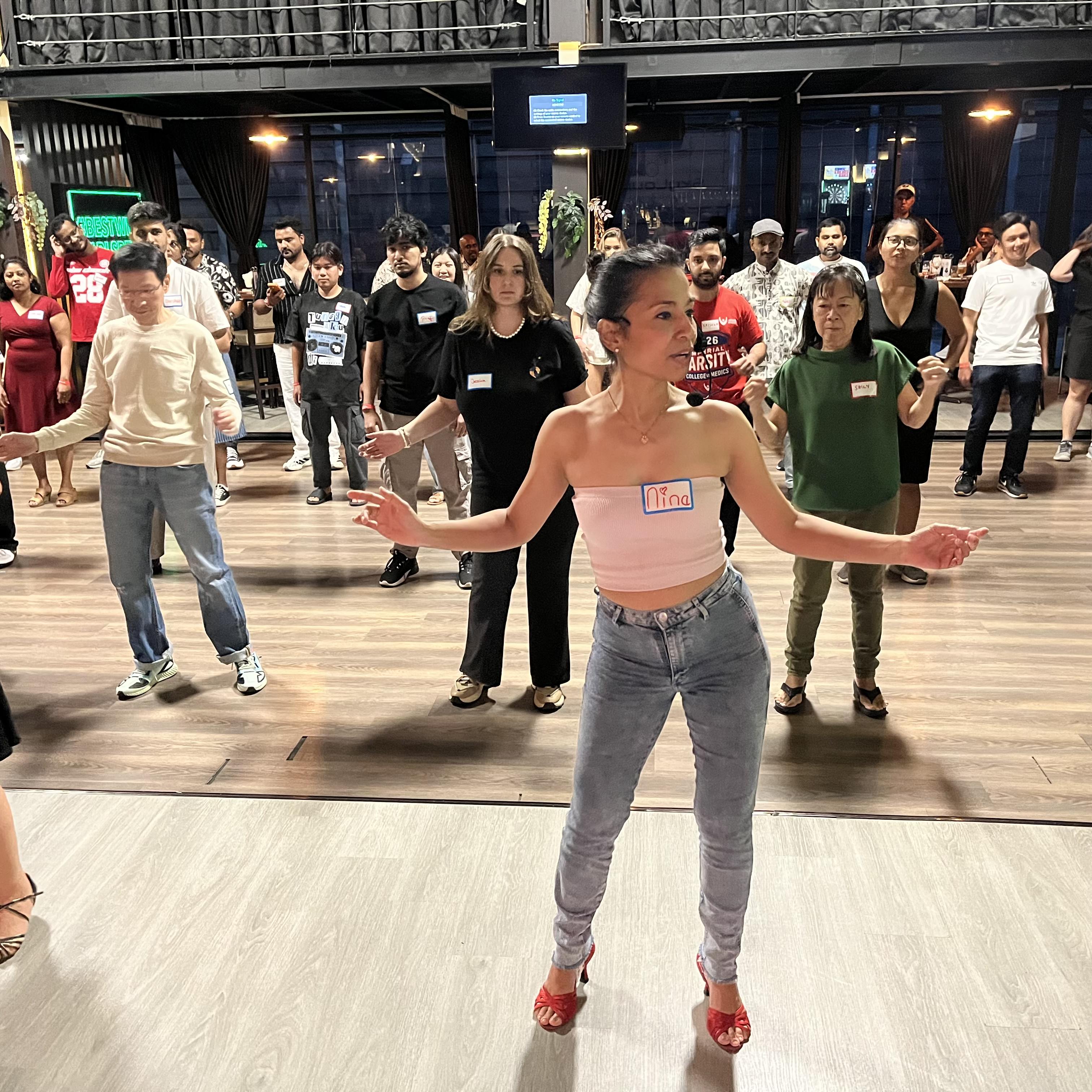
Every dancer remembers the moment their feet finally felt free. Nine times out of ten, it happened because of the right shoes. The other one time? They were barefoot. Also valid.
I get asked about shoes at almost every class, and honestly, I love it — because it means you've caught the bug. You're not just showing up anymore. You're thinking about the floor, the spin, the way you want to look and feel when the music drops. So let's talk shoes. Properly. No fluff, no vague gestures toward "just get something comfortable." Real talk.
First: why your favourite sneakers are working against you
I know. They're comfortable. They match your outfit. You've had them for three years and they feel like old friends. But here's what's actually happening when you wear standard rubber soles on the dance floor: they grip. Really hard. Your foot plants itself firmly while the rest of your body tries to turn — and all that torque goes straight into your knee. Do that for a whole social night and you'll be limping home wondering why bachata hates you. Bachata doesn't hate you. Your shoes do.
Proper dance footwear — whether heels, flats, or dance sneakers — shares one critical feature: a sole engineered for the right balance of slip and grip. Enough traction to stay grounded, enough glide so your spins are clean and your body can actually move the way the music wants it to. The first time you dance in the right shoes, something clicks. Turns feel lighter. Connection improves. You wonder what you've been doing to yourself all this time.
Where to shop — your options
Budget-friendly options already in our group chat
Hidayah has already shared two links in the group — thank you Hidayah! One from Shopee, one from Temu. The Temu pair has suede soles so it qualifies as a proper dance shoe. Great starting point if you want to try dancing in the right footwear without a big upfront commitment.
KL's two trusted dance shoe makers
In KL, our dance community is a close and small one — and we are fortunate to have two well-established local makers who have served dancers here for years. Both KY Shoes Collection and San Lee Shoes are the real deal: they know our floors, our styles, and what dancers need. Here is how they each show up in practice.
KY Shoes Collection
My personal go-to, and the shoes I reach for when I perform. I wear KY for training, for socials, and on stage — across salsa, bachata, and more. What I notice most is the cushioning: generous and well-distributed, which makes a real difference across long nights and multiple spins. The balance feels precisely calibrated, and the fit from custom orders is consistently excellent.
They regularly bring in new trending fabrics — shiny, matte, metallic, printed — and going in person to choose your materials is part of the joy.
Plan ahead: KY can have a waiting list. Worth every bit of the wait if you can be patient.
San Lee Shoes
San Lee is a genuine and long-standing part of KL's dance community. Many dancers — myself included, during my years training at Havana Studio — have worn San Lee shoes on the floor, and they've served us well. They offer both custom and ready-made pairs across a solid range of styles.
Compared to KY, the sole construction is firmer and the cushioning sits closer to the foot. For some dancers, that's actually a preference — more direct floor feel. Where it makes a difference is on very long social nights, or if spinning comfort is your priority.
San Lee's real strength: speed. When KY's waiting list doesn't fit your timeline, San Lee can often get you into a well-made pair much faster — and in our small community, that kind of reliability matters.
Choosing your heel — ladies
This is where I see the most confusion — and, I'll be honest, the most unnecessary suffering. The number of dancers I've watched hobble through an entire social in heels that were three sizes too ambitious for their current skill level... let me save you from that fate.
The general consensus among dance shoe specialists and fitters is to start low and earn your height. Most beginners feel most comfortable and in control at around 1.5 to 2 inches. Once you have some floor time under your feet, 2.5 inches is the standard everyday Latin social dance height — it's what most experienced social dancers wear for long evenings and congresses. Three inches and above is where the elegance really comes in — but also where your ankles need to be ready.
| Height | Who It's For | Notes |
|---|---|---|
| 1.5 – 2 in | True beginners, teaching days, all-day workshops | Start HereMaximum stability while your feet learn what dance footwork actually feels like. Not glamorous — but neither is falling over in your first social. |
| 2.5 in | Social dancers, congresses, long nights | Everyday Latin HeightThe standard across the social dance world. Enough elevation to shift your weight for turns, without punishing your feet by midnight. Even experienced dancers default to this for long events. |
| 3 in | Intermediate and above, regular social dancers | Nina's Daily HeightWhere elegance and control meet. Go flared heel, not stiletto, at this height — especially for bachata. This is also the height where being five feet tall starts to feel like a superpower rather than a footnote. 😉 |
| 3.5 in | Experienced dancers, performance | Earn It FirstBeautiful leg line. Demands strong ankles, reliable balance, and a core that won't abandon you mid-spin. Glorious when the technique is there. Humbling when it isn't. |
| 4 in + | Showcase / stage performance only | Advanced OnlyStunning on stage. Every extra inch shifts roughly 25% more of your body weight onto the ball of your foot. The math is not on your side unless your ankles absolutely are. |
Flared heel vs stiletto — and yes, it matters
The shape of the heel matters almost as much as the height. A flared heel — wider at the base — is more forgiving for beginners, long nights, and anyone who's ever had to recover their balance mid-bachata-dip (it happens, no judgement). The broader base spreads your weight and gives you a real margin of error. A stiletto is sharper, more dramatic, genuinely beautiful — but it demands precise balance and ankles you trust completely. For bachata especially — with its lateral step, deep knee bends, and those slow, delicious body rolls — start flared. You can always go sleeker once your feet know what they're doing.
A personal note: I'm five feet tall, which in dance terms means heels are less of a choice and more of a commitment to being seen. My working height is three inches. I've gone as high as three and a half — beautiful, earned, and absolutely worth it. But I started at two and a half, like most people should, and I moved up when my body told me it was ready. Your body will tell you too. Listen to it.
"Make sure the shoes fit you — or are you going to make sure you fit the shoes?"
Choosing your shoes — gentlemen
Good news, leaders: your world is simpler. Two choices, basically. You're welcome.
The standard for Latin dance is the Cuban heel — a broad, block-style heel sitting between 1 and 2 inches high. It shifts your weight slightly forward onto the ball of your foot, which is exactly what gives Latin dance its characteristic posture, attack, and that undeniable swagger. I have a pair of cotton Cuban shoes and a heeled Cuban pair, both from KY Shoes Collection, and I love them both. Yes, I — your instructor — have strong opinions about men's dance shoes. This is where we are now.
Go custom if you can. The fit around the heel and forefoot affects how much floor feedback you actually feel through the sole — and floor feedback is how you lead well. A shoe that fits badly is essentially noise between you and the floor. You want signal.
And please, I'm asking you nicely: get something with a little personality. White. Maroon. Black and white stripes. Something that makes people glance down mid-dance. You've been putting in the hours, drilling your cross-body leads, working on your musicality. Let people look at your feet. You have absolutely earned the right to a shoe that says something.
What about dance sneakers?
Heels are not the only path. More and more dancers — especially those coming through Brazilian Zouk or Bachazouk — are choosing dance sneakers, and honestly, good for them. These styles are beautifully grounded: lots of fluid body movement, weight shifts, close connection. Heels can work, but they add a layer of challenge that's just not always necessary, especially when you're still building your foundation.
The critical word here is dance sneakers. Not your gym trainers. Not your favourite Nikes. Not the ones you wore to the gym yesterday and definitely didn't clean. Regular sneakers have rubber soles built to grip the floor — which is, as we covered, precisely the problem. The grip that makes you safe on a wet pavement is the same grip that will wreck your knees when you try to spin.
Dance sneakers are engineered differently. Their soles give you controlled slip — smooth enough to turn cleanly, grippy enough to not go sliding into a stranger. They look like streetwear. They perform like dance shoes. Best of both worlds, no wobbling required.
Brands worth knowing
Fuego is the most visible name in this space — you'll see them at socials and congresses the world over. Their signature is the FlowTec™ outsole with dual pivot points: small, smooth zones engineered into the sole exactly where your foot pivots during a spin. They don't rotate independently (a common misconception) — they simply reduce friction at the precise spot where you need it, so turns feel noticeably cleaner. They also do a split-sole version, which gives you more foot articulation for pointing and flowing. Available in low-top and high-top, plenty of colours.
Taygra, from Brazil, is the other name you'll hear constantly in Zouk circles — to the point where it's become a community in-joke that Taygras are basically the unofficial zouk uniform. Lighter and more minimal than Fuego, with a sole that glides beautifully and a very thin feel that keeps you close to the floor. One note: they run lighter on arch support, so many dancers slip in padded insoles for long social nights. Size up by half — both brands run small.
Sole construction — the detail most people skip
When you order custom shoes, you'll be asked about sole hardness. Most people shrug and pick randomly. Don't be most people. The internal construction of the sole determines how much your foot can actually articulate — whether you can point, flex, and express through your feet while you're dancing. In Latin dance, that expression is part of the vocabulary. It matters.
| Soft Sole | Semi-Hard Sole | Hard Sole |
|---|---|---|
| Maximum flexibility. Your foot can point beautifully and respond to every nuance of the music. Preferred by performers and choreography-focused dancers. Less structural support, so your feet will feel it on very long wear. | The sweet spot — and the one I reach for most often. Enough support to dance confidently for hours, still flexible enough to point and express when the music calls for it. If you're not sure what to choose, choose this. | Maximum support and stability. Great for beginners, or anyone whose feet are not yet used to dancing for hours. Trade-off: less foot articulation. You won't be pointing as beautifully, but you'll be upright at the end of the night. |
Picking your colour — and yes, this is the fun part
I'm going to tell you something now and I need you to receive it calmly: once you have dance shoes, you will buy more. This is not a prediction. This is a law of nature. Every dancer I know has at least three pairs and counting, including the ones who said "I'll just get one practical pair." There are no practical pairs once you've seen what's possible. Let me guide you wisely through this inevitable journey.
- 1First pair: go neutral. Black, nude, or dark tan. Not because neutral is more virtuous — it isn't — but because neutral goes with everything and removes one decision from your plate while you're still learning to dance. Think of it as your foundation pair. Every shoe wardrobe needs one.
- 2Then: go absolutely wild. The foundation pair is a responsible adult decision. Every pair after that is between you and the music. Sparkly. Rhinestoned. Electric blue. Rose gold. Something that makes the person dancing opposite you involuntarily look down. This is correct behaviour. This is encouraged.
- 3"Noticed on the floor" beats "matches my dress" every time. We are not going to dinner. We are going dancing. Flamboyant, sexy, dramatic, a little bit outrageous — these are compliments on the dance floor, and you should chase all of them.
- 4Go in person to choose your materials. At KY and San Lee, you pick your fabric — shiny satin, matte suede, metallic, printed, iridescent, whatever they've just received. New fabrics come in regularly. Run your hands over everything. Hold swatches under the light. Imagine it under the disco ball. This is the best part of going custom, and it cannot be replicated by scrolling a website.
Looking after your shoes
A well-maintained pair of dance shoes can last years. A neglected pair can go south in a few months. The difference is honestly about five minutes of attention after each session. Here's all you need to know.
- Get a wire suede brush. Use it regularly. The suede sole picks up dust, floor wax, and general grime, which mats the fibres down and turns your beautiful grippy sole into a slippery liability. Brush it back to life after every session if you dance frequently — or whenever the floor starts to feel less responsive under you. Short firm strokes, over a bin. Don't overdo it: too much brushing wears the suede down prematurely. Let the sole tell you when it needs attention.
- A shoe bag is not optional. It's how you keep the "never outside" rule. Carry your shoes in, change when you arrive, change back before you leave. Your future self — the one who still has beautiful soles in two years — will be grateful.
- Let them breathe after dancing. Don't seal warm shoes straight back into a bag. A few minutes of air does more for longevity than most people realise.
- Worn thin? See a cobbler before you replace. When the suede starts to feel paper-thin underfoot, a professional cobbler can often resole your favourites for a fraction of the cost of a new pair. Ask before you assume it's over. Good shoes deserve a second life.
See you on the floor. May your turns be clean, your shoes be fabulous, and your soles always freshly brushed. 💃 — Nina, KL Social Society